
How Food and Beverage Companies Optimize Freight Procurement and Carrier Management in One Platform
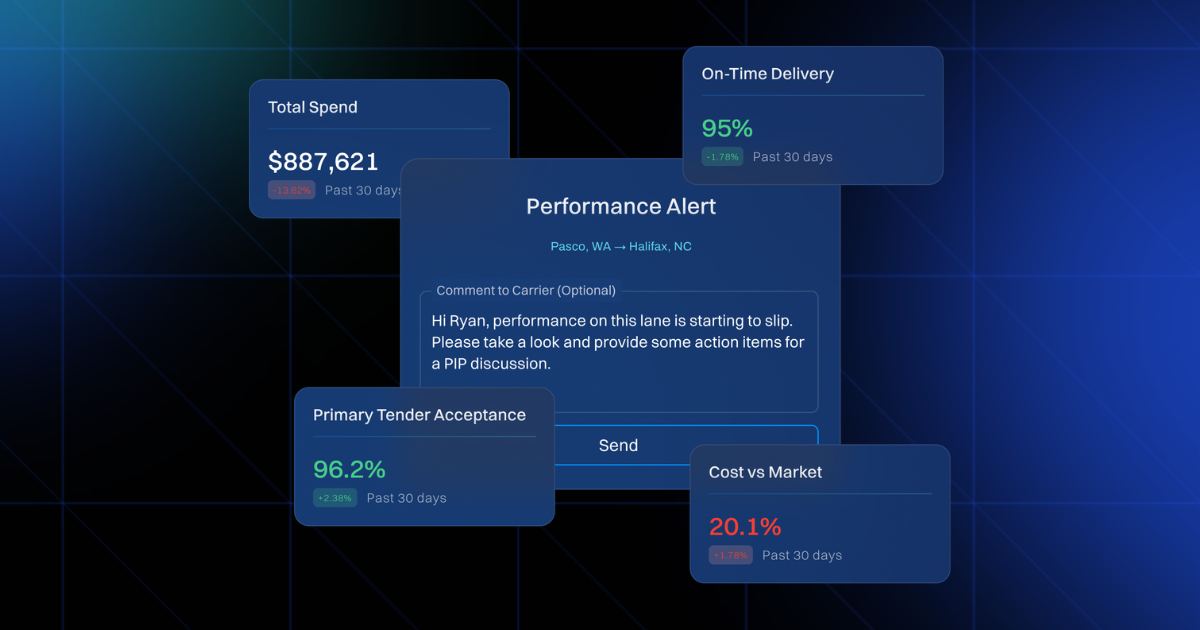
Food and beverage transportation teams operate under tighter constraints than most. Short shelf life. High service expectations. Narrow delivery windows. Constant pressure on cost. Procurement and carrier management both matter, but they are often handled separately. Procurement happens during RFP cycles. Carrier performance gets reviewed later, usually after issues show up. That separation creates friction. Decisions made during procurement are not always connected to how the network actually performs. And by the time performance issues are visible, the opportunity to fix them has already passed. What leading teams are doing differently is bringing those two functions together into a single system.
Why Procurement and Carrier Management Need to Be Connected
In most organizations, procurement answers one question: which carriers should we award?
Carrier management answers a different one: how are those carriers actually performing?
The problem is that these two answers are rarely connected in real time. That gap shows up in practical ways:
- Strong bids that lead to poor execution
- Reliable carriers that are underutilized
- Cost increases that are hard to explain
For food and beverage companies, these issues are amplified. Service failures do not just affect cost. They affect product quality and customer relationships.
Teams need to understand not only what they are buying, but how those decisions play out across the network.
What This Looks Like in Practice
Companies like Rise Baking, Michael Foods, and Reser’s are all working toward the same outcome: a more connected view of their transportation network.
The common thread is visibility.
At Rise Baking, the challenge was not a lack of data. The team already had access to extensive transportation data across their network. The issue was turning that data into something usable for decision-making.
By implementing GoodShip, the team gained a unified view of their network. They could evaluate lane-level competitiveness, monitor carrier performance, and identify service risks early.
This changed how procurement and carrier management worked together. Instead of waiting for performance issues to surface, the team could see where lanes were out of alignment with the market and adjust proactively.
From Procurement Events to Continuous Decision-Making
At Michael Foods, the goal was to move toward a more data-driven transportation strategy.
The team needed a way to connect procurement decisions with broader business outcomes, including service performance and cost-to-serve at the customer level.
With GoodShip, they were able to:
- Evaluate lane competitiveness against the market
- Identify exposure areas before procurement cycles
- Analyze service performance and cost together
This allowed them to address issues earlier, rather than reacting after costs or service problems had already impacted the business.
The shift is subtle but important. Procurement is no longer a periodic exercise. It becomes part of an ongoing decision loop tied to real network performance.
Improving Carrier Collaboration with Better Visibility
Carrier management is not just about measuring performance. It is also about improving relationships.
At Reser’s Fine Foods, the focus was on strengthening collaboration with carriers while improving visibility across the network.
When teams have a clearer view of:
- Service performance
- Delivery reliability
- Network trends
Conversations with carriers become more productive. Instead of reacting to isolated issues, teams can address patterns and align on improvements.
This leads to more stable carrier relationships and better long-term outcomes.
What Enables This Shift
The underlying change across all of these examples is not process. It is access to better, more connected information.
GoodShip brings together transportation data across:
- Loads
- Carriers
- Contracts
- Procurement events
- Market benchmarks
This creates a single view of the network that teams can use for both procurement and carrier management.
On top of that, tools like Laney AI for Transportation Teams make it easier to interact with that data.
Instead of building reports manually, teams can ask questions directly and get immediate answers. Laney is designed to analyze carrier performance, model procurement scenarios, and surface optimization opportunities based on real network data.
That reduces the time between identifying a question and acting on it.
What Changes for Transportation Teams
When procurement and carrier management are connected in one platform, teams start to work differently.
They can:
- Evaluate bids with a clear understanding of carrier performance
- Identify risks before they show up in execution
- Adjust strategies based on real-time network conditions
Instead of switching between systems or relying on manual analysis, teams operate from a single source of truth.
This also changes how decisions are communicated. Insights can be shared across operations, procurement, and leadership without additional preparation.
At Michael Foods, for example, insights from GoodShip are used across multiple levels of the organization, from planners to leadership, to align transportation decisions with broader business goals.
Why This Matters More in Food and Beverage
In food and beverage, transportation decisions have a direct impact on product quality and customer experience.
Late deliveries are not just service issues. They can lead to spoilage or lost shelf space.
Carrier reliability is not just a metric. It is part of how the brand shows up to customers.
That makes visibility more important.
When teams can see:
- Which carriers consistently meet service expectations
- Which lanes are at risk
- Where costs are trending out of range
They can act earlier and with more confidence.
The Role of a Single Platform
The benefit of bringing procurement and carrier management into one platform is not convenience. It is consistency.
Data stays connected. Decisions are based on the same information. Teams are aligned around the same view of the network.
With GoodShip Transportation Procurement, companies can manage sourcing events while also understanding how those decisions affect execution.
That connection is what allows teams to move from reactive problem-solving to more proactive network management.
The Bottom Line
Food and beverage companies do not need more tools. They need better alignment between the tools they already use.
Procurement and carrier management are two sides of the same problem.
When they are connected:
- Procurement decisions improve
- Carrier relationships strengthen
- Network performance becomes easier to manage
The companies that are getting this right are not doing something radically different. They are simply working from a clearer, more connected view of their transportation network.


